Facts About Home Insurance & Trees

It’s becoming way too common, especially in Texas, homeowners receiving a threatening letter from their insurance company to drastically remove all tree limbs over a structure to prevent them from falling onto the house.
Don’t let their threat make you react out of fear, you actually have options.
What To Do If You Receive a Letter Threatening Loss of Insurance Due to Trees Hanging Over Your Home
- Working with your home insurance carrier is the first step. Be aware there are certain insurance carriers that are blatantly trying to get out of the Texas market due to the uptick of storms.
- Schedule an appointment with a certified arborist from Texas Tree Surgeons. They will go over science backed options to help create solutions that do not necessarily mean a doom spiral for your tree.
- Ask your insurance provider to come on sight to see your home and trees. Solely relying on satellite imaging to dictate compliance won’t reliably tell the amount of actual risk.
- You have leverage to fight back if they are only looking at the tree from a singular angle since that doesn’t completely show the tree’s structure or health to determine risk.
- Submit a letter from a credentialed arborist who is trained in TRAQ, Tree Risk Assessment Qualification, with factual information of your tree’s health and risk of property damage.
- Make sure you submit any response and communication with your insurance prior to the arbitrary date they give you. If your home insurance is dropped it will be harder for you to acquire new insurance.
- There are other insurance companies that are more likely to work with you, versus against you. Again some of these insurance companies are doing within the limits of legality to get out of Texas.
Making informed choices in tree care reduces risk. The biggest risk for tree failure is due to over pruning because it leads to structural instability in the tree. The short-sighted approach of removing all limbs overhanging a home makes them more unhealthy and dangerous.

It is a Fallacious Argument to Remove All Limbs Hanging Over a Home
- Fact one, removing all limbs overhanging a house does not diminish your risk.
- The offset and deficit your tree experiences from a drastic reduction is going to make your tree go into hyper drive to produce more sprouts where the limbs were removed. These sprouts will be less structurally sound and will create more frequent dropping.
- Fact two, this shock of excessive pruning will create stress to the tree, making it less healthy and prone to fail.
- Fact three, removing only limbs that overhang the home will create a disproportionate load on the tree. With the tree being unbalanced this will make it less safe and structurally unsound.

with your insurance company our tree trimming practices.
What Are Best Practices to Limit Risk of My Tree Failing?
Urban trees face a lot more stressors than trees found in a forest. Reducing stressors will create a healthy tree that will increase its vitality and lessen its risk to fail.
Preventive measures include:
- Water Wisely – Use deep, infrequent watering and consider drip irrigation to support root health without overwatering.
- Prune Strategically – Remove dead, broken, or diseased limbs, or dead trees before they fail. Taking these steps can mitigate the risk of damage and protect your insurance standing. Over pruning leads to more failures than you’d assume. Removing large sections of a tree that over hang on top of the house will actually make the tree more likely to fail. When drastic changes are made to a trees structural shape it will cause the tree to lose its structural integrity by making it imbalanced. Trees are a living organism that naturally lose branches or fall.
- Apply Mulch – A 1-2 inch layer of mulch conserves moisture and insulates roots—but keep it away from the trunk to prevent bark rot.
- Annual Arborist Assessments – Having a certified arborist routinely inspect your trees can help ensure trees are not weakened by improper care
- Plant Native Trees – Native trees tend to be more resilient to local conditions, thereby requiring less invasive maintenance and posing less risk to structures.

Following Tree Trimming Best Practices Will Limit Risk
At Texas Tree Surgeons we adhere to the guidelines set forth by the ISA (International Society of Arboriculture) and ANSI (American National Standards Institute) for trimming, which include; crown cleaning, thinning, raising, and reducing (only performed when appropriate).
- Dead and Damaged Wood Removal – Removal of dead, dying, diseased, and structurally unsound branches within the crown.
- Raising the Tree – Raising your tree provides sufficient vertical clearance to walk underneath and ensures it is away from any structures, which is often required to comply with city codes.
- Selective Trimming of the Tree – Selective trimming is the artful removal of living plant material from dense areas within your tree. This process helps reduce weight and allows wind to pass through the tree more safely.

Monetary Benefits of Trees
- Trees take time to grow, established large trees add value to a home.
- Trees provide shade and reduce costs in the summer by cooling the home.
- Removing full grown trees is expensive, and unnecessary if they are healthy.
You can count on Texas Tree Surgeons to support you in providing factual information in creating a response or plan to keep your tree stable while also protecting your home. The idea that no trees should be near any house creates a neighborhood that few people would want to live in. When choosing a tree company to prune your trees it is important to select one that adheres to the guidelines set forth by the ISA (International Society of Arboriculture) and ANSI (American National Standards Institute) to ensure they are not causing harm and more risks to your trees.

At Texas Tree Surgeons we love trees and hope that insurance companies will recognize that while trees pose some risk when near structures, their benefits outweigh those risks. Properly maintained trees enhance your property’s aesthetic value and offer numerous environmental benefits. The misalignment of insurance carriers and environmental care is a growing issue.
Government oversight is necessary to support homeowners instead of bottom lines.
 PREV BLOG
 Tree Triming
View Photos of our Highly Trained Crew's Getting the Job Done

HIGHLY SKILLED CLIMBERS
Our crews are comprised of individuals with different areas of expertise. Our highly skilled climbers use several types of PPE to keep them safe while in the canopies of the trees.
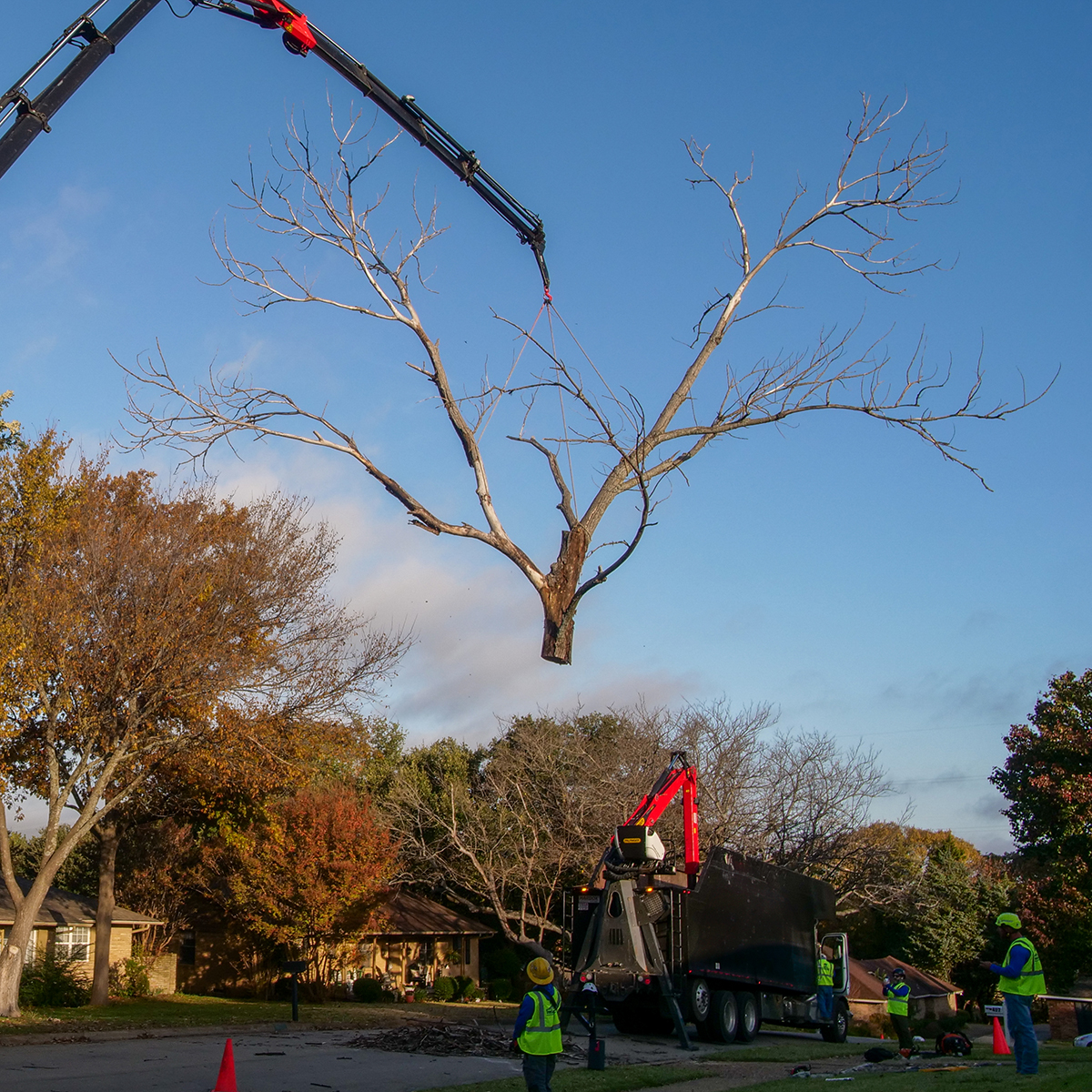
WHY USE A CRANE FOR TREE REMOVAL
What determines if a crane should be used over climbers is when; root rots such as Ganoderma or Kretzchmaria make the tree weak and structurally unsound, splitting, hornets living inside the hollow, or a tree to far gone from Hypoxylon Canker.

CLIMBING LINE & DRT
Safety for our climbers and your property is important to us at Texas Tree Surgeons. Our climbers use climbing line (specially designed rope) and use DRT (Double Rope Technique) to help them move safely within the tree canopy.

INSURED AND BONDED
Our crews work together to come up with the best plan to safely remove trees from a site. All of our employees train under a Certified Arborist to ensure best practices are always followed.

ARBORIST AND CREW WORKING TOGETHER
We hire only the most experienced climbers to trim trees, and all our employees train under a ISA Certified Arborist.

BEST TIME TO TRIM
Best practice is to trim certain trees during dormant periods, making fall and winter generally the best time. To learn more about best practices for when you should trim your tree click here.

TCIA & ISA GUIDELINES
We strictly adhere to TCIA & ISA guidelines in order to ensure everything we do is safe and in the best interest of your trees. By getting your tree assessed by our team of ISA certified arborists and trimmed by one of our skilled crews is the best way to ensure that your tree lives a long and healthy life.

PROTECTING PROPERTY FROM DAMAGE
Using climbing line to secure branches while trimming is important to keep your property and climbers safe. They are able to control the branches descent and place it gently onto the ground below.

SMALL SPACE WORK
Trimming and removing trees in small spaces takes extra time and extra care. Each piece must be cut and lowered with exact precision to avoid damage to property.

TYING OFF LIMBS FOR SAFETY
When trimming trees over structures, larger limbs need to be tied off so they do not damage the roof or the structure itself.

CRAPE MYRTLE TRIMMING
Crape Myrtles are beautiful and hardy trees when cared for properly; topping Crape Myrtles is a bad practice and not recommended.

SAFETY FIRST
To ensure a safe work environment groundsmen will clear excess debris intermittently while tree trimming or removal takes place. Clearing the site as the tree is trimmed also ensures jobs are done in a timely manner.

THE RIGHT-SIZED CREW FOR EVERY JOB
We work with crews of different sizes to make sure that every job is done safely, quickly, and efficiently.

TREE TRIMMING
Our experienced climbers safely climb into the tree canopies to properly trim branches.

ATTENTION TO DETAIL
Our goal when we leave a job site is to leave it looking better than how we found it. That means picking up any debris that were created when trimming or removing a tree.

FULL CLEAN-UP
To ensure a job is completed quickly groundsmen will haul away brush intermittently while trimming or removal happens to keep the site clear and safe to move around. Groundsmen will chip the material on-site as needed to make sure all debris is collected and removed at the end of the job.

COMPLETE DEBRIS REMOVAL
At Texas Tree Surgeons we include debris haul off with all of our trim and removals. If you would like any of the wood left on site for your personal use (e.g. firewood) just let us know, we are happy to help.
Related Blogs
Similar blogs related to this topic


Entire Arborist Staff are Prescription Pruning Qualification Certified
Texas Tree Surgeons is proud to announce that all of our certified arborists can add Prescription Pruning Qualification Certified to their list of credentials. Lindsey Bramer, General Manger Will King, Consulting Manager Hannah Edinburgh, Arborist…
Read more 
Root Pruning
Root pruning is more damaging to mature trees than it is for younger more vigorous trees. With that said, at Texas Tree Surgeons we can prune roots of healthy trees. Using certified arborists will minimize…
Read more 
Avoid These Tree Care Mistakes for a Healthy Landscape
Below is a list of overlooked mistakes that could jeopardize the health of your trees. From missteps in pruning to incorrect watering practices, discover how to give your trees the care they deserve. Red oak…
Read more