• Skip to main content
  • 469-387-6000
  • [email protected]
  • Local Arborist
  • Services

    All Services

    Local Arborist

    Consulting

    Tree Trimming

    Tree Removal

    Tree Health Care

    Tree Planting

    Stump Grinding

  • Service Area
    Addison Allen Arlington Carrollton Colleyville Coppell Dallas Denton Euless Farmers Branch Flower Mound Fort Worth Frisco Garland Grand Prairie Grapevine Highland Park Irving Keller Lewisville McKinney Mesquite Murphy North Richland Hills Plano Prosper Richardson Rockwall Southlake Trophy Club University Park Wylie
  • Information
    About How We Work Faqs “Arborist” vs. “Certified Arborist” Emergency Tree Work Gallery Insurance and W9 Information
  • Testimonials
  • Blog
    All Blog North Texas Tree Owner’s Guide Tree Recommendations Insects & Diseases Whats Wrong with My Tree Fall Tree Care Winter Tree Care Spring Tree Care Summer Tree Care
  • Pay Invoice
  • Contact Us
  • Local Arborist Services
  • Tree Health Care
  • Roots
  • Fall Tree Care
  • Winter Tree Care

Vertical Mulching to Improve Root Health and Combat Soil Compaction in Texas
Jul 16, 2026

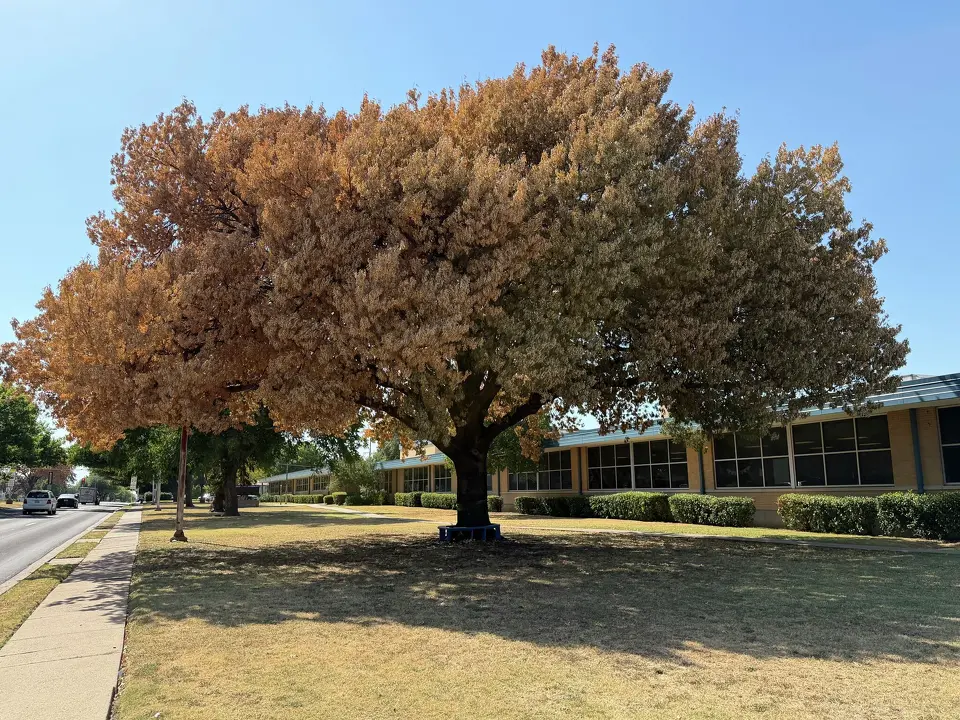
If you’ve ever tried digging a hole in your Dallas yard, you know exactly what our local trees are up against. Between our heavy, stubborn Blackland Prairie clay, heavy spring rains, and the intense Texas heat waves, the ground beneath our feet often feels less like life-giving soil and more like poured concrete. When the soil compacts, your trees literally begin to suffocate. Fortunately, we have an effective, technique we use to fight back: Vertical Mulching.

Here is a look at what this process is, why your North Texas trees desperately need it, and how it works to save your canopy from the bottom up.
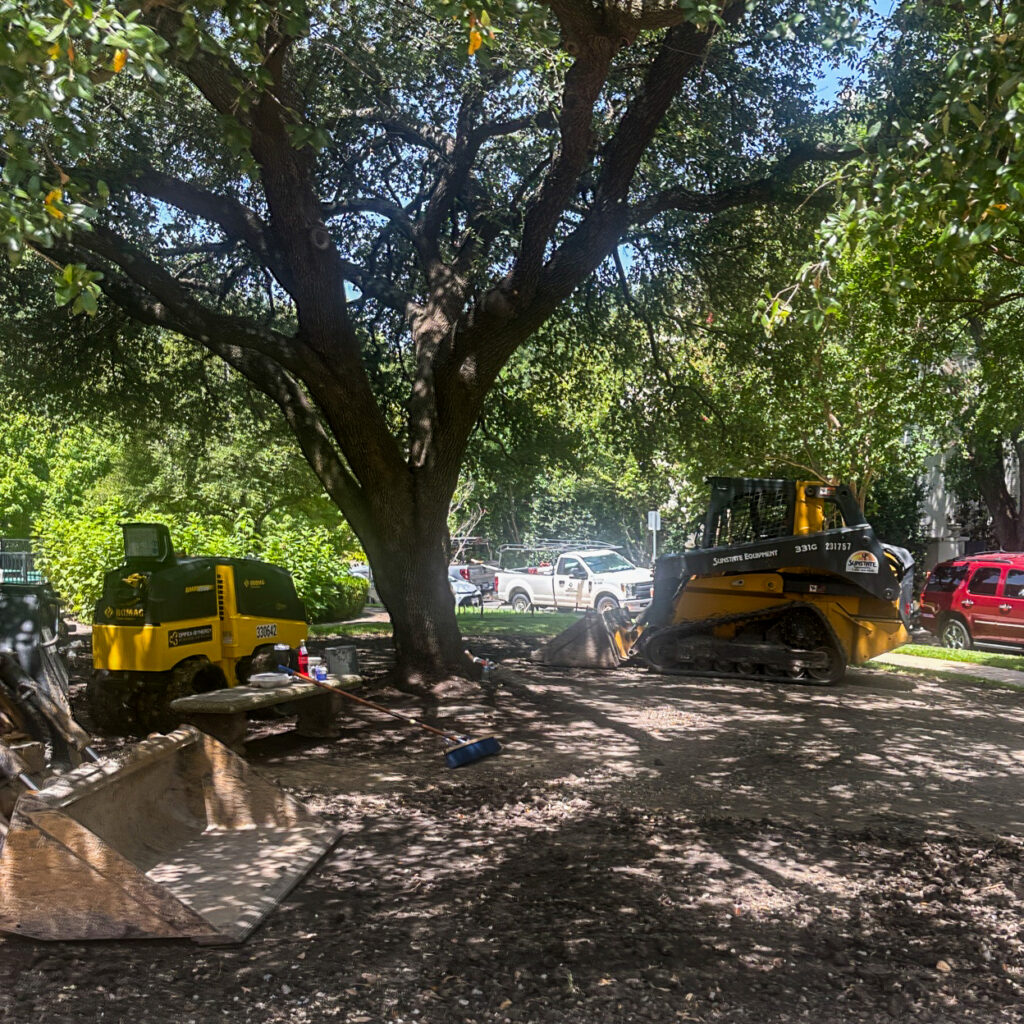
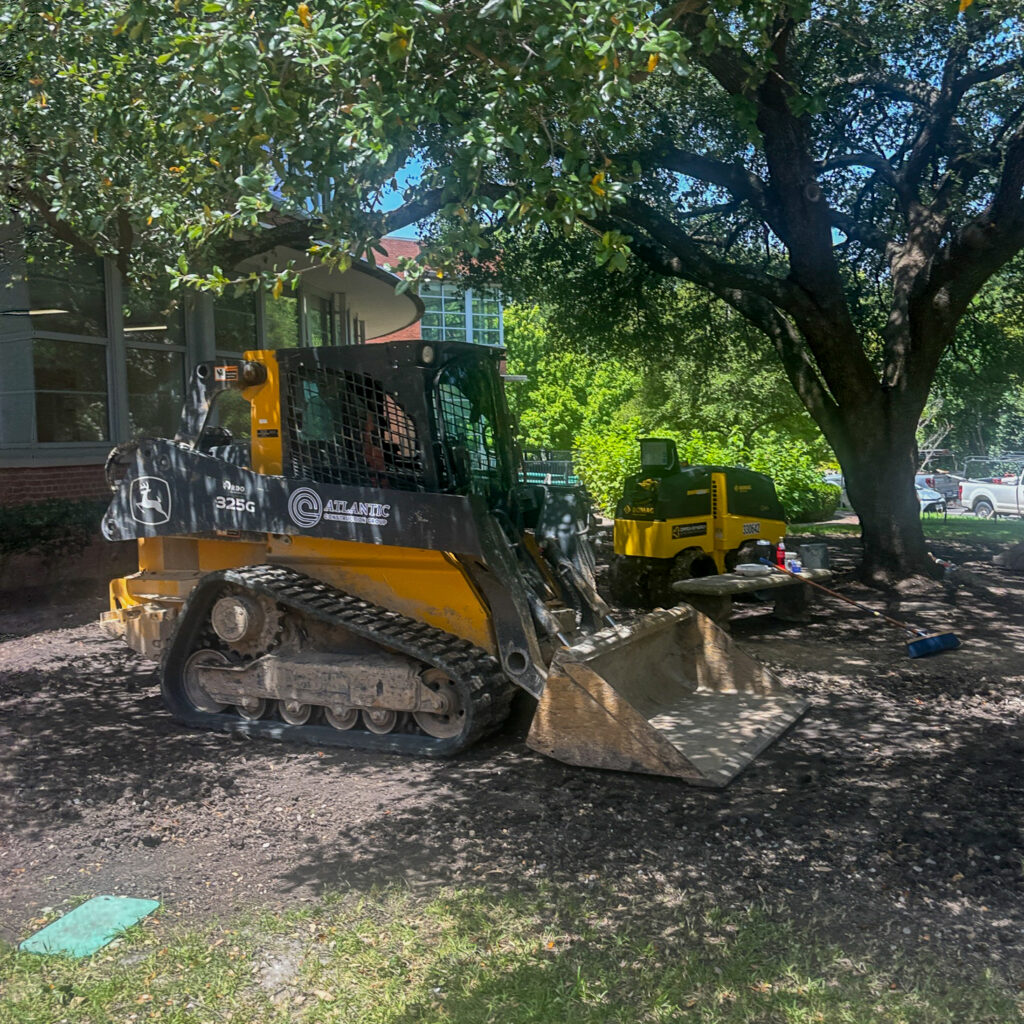
No construction protection zone around the live oak tree. Heavy machinery is sitting under the canopy is compacting soil and restricting air flow and nutrient uptake though the fine roots.
The machinery that is sitting on top of the soil is at minimum 2,500 pounds. This weight presses on the soil reducing air flow which suffocates the tree.

The Silent Killer: Soil Compaction

In a natural forest, trees thrive because centuries of fallen leaves, twigs, and organic matter decay into a soft, spongy layer of topsoil. This creates an ideal balance of about 50% solid particles and 50% pore space—the micro-pockets where crucial oxygen and moisture sit.   

In our urban Dallas neighborhoods, that cycle is broken. Between construction traffic, heavy lawn mowers, foot traffic, and the natural characteristics of clay, those vital pore spaces are greatly reduced. 

When soil compacts:

  • Roots suffocate: Tree roots are alive and require oxygen to breathe.   
  • Water runs off: Rainwater from intense Texas storms can’t penetrate the hardpan, running right off into the street instead of sinking down to the root zone.
  • Roots can’t expand: The mechanical resistance becomes so intense that delicate, water-absorbing feeder roots physically cannot push through the earth.   

If you notice your mature live oaks, maples, or cedar elms exhibiting sparse canopies, smaller-than-usual leaves, or branch dieback starting at the very tips of the crown, your soil is likely screaming for help.
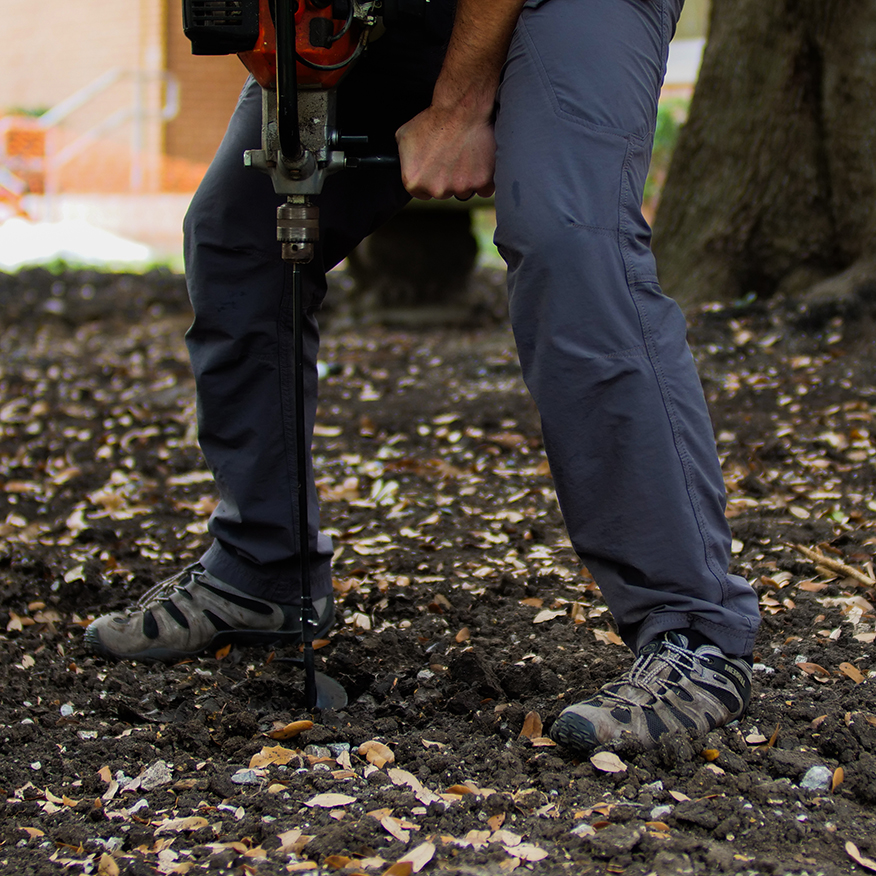
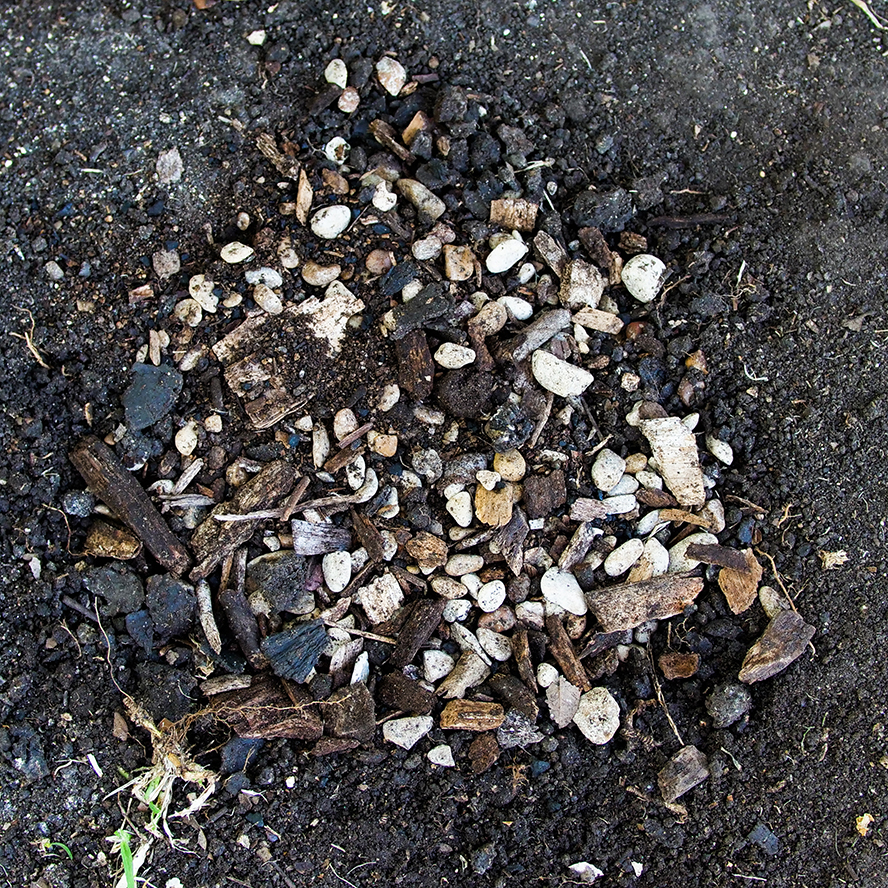
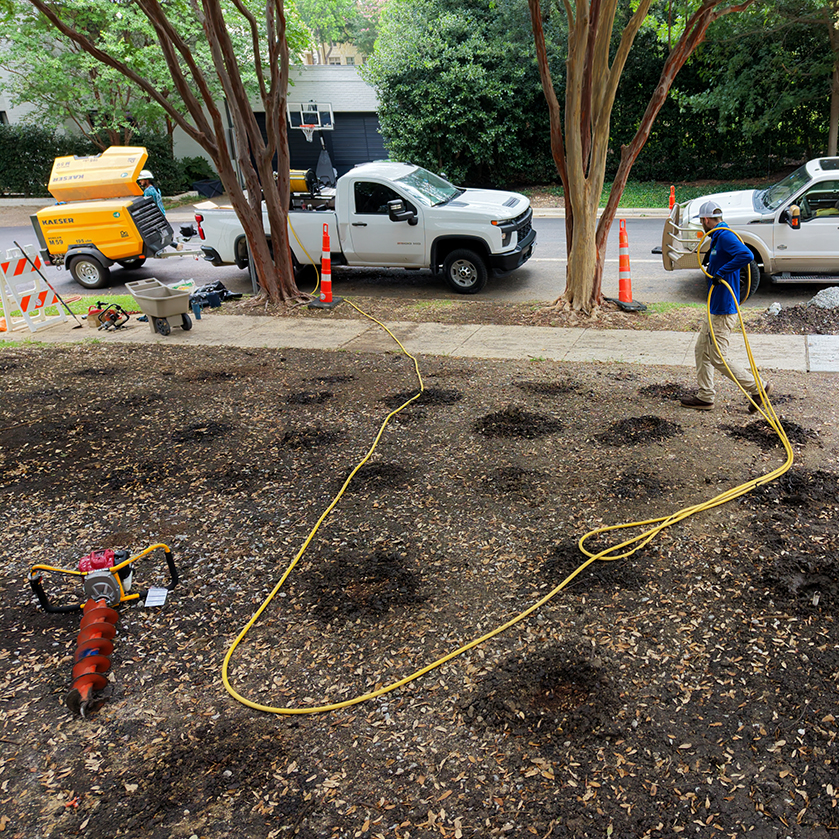
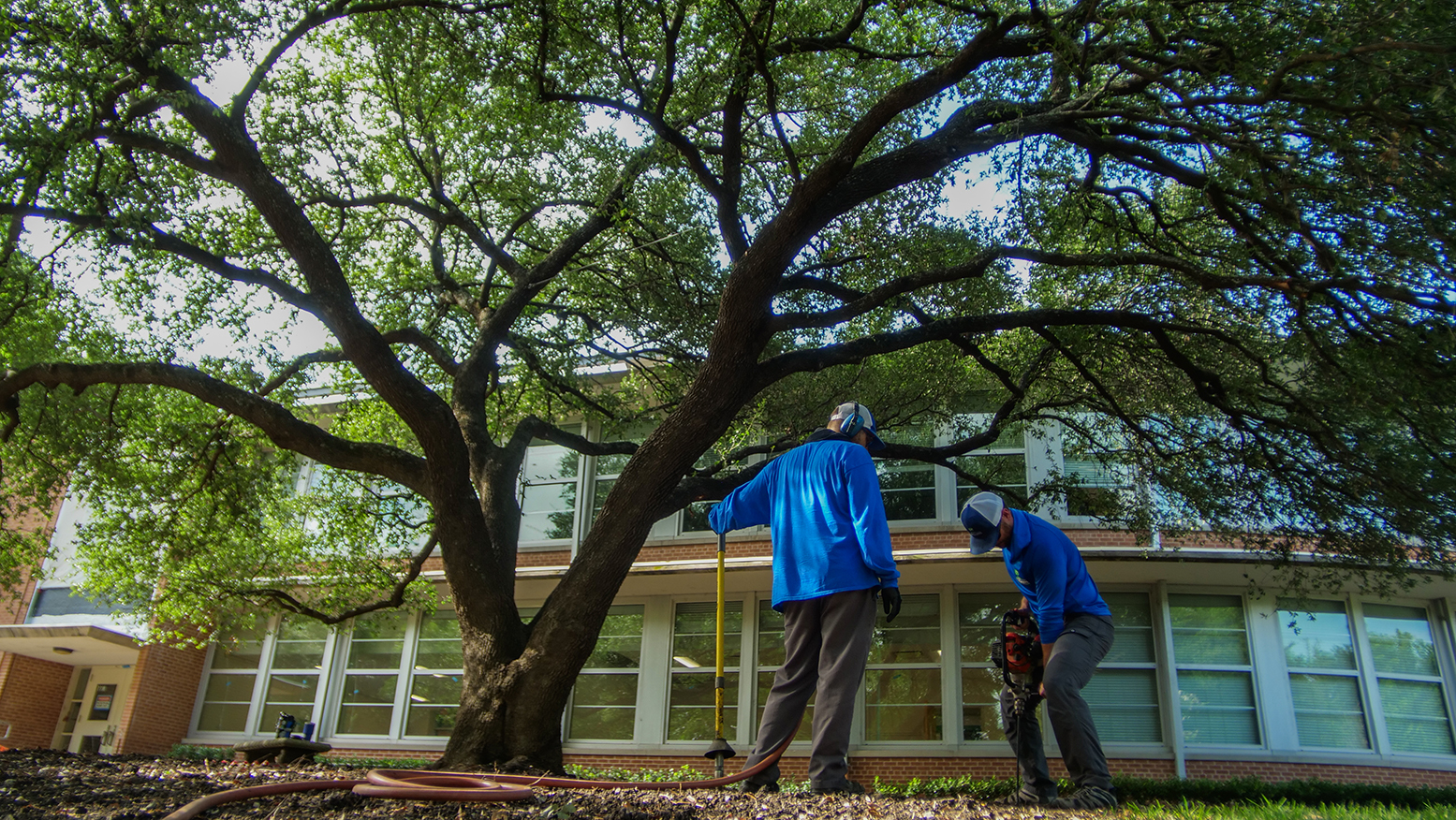
Using specialized tools—such as a high-velocity air spade or an auger to create columns that are between 8 to 18 inches deep.
These vents are back filled with a porous blend of materials to increase water absorption and reintroduce oxygen straight to the subterranean level .
Vertical mulching radiates around the trunk of the tree and expands to the trees dripline.

What is Vertical Mulching?

Think of vertical mulching as a targeted, deep-tier aeration system designed specifically for a tree’s root infrastructure.

Instead of just laying mulch on top of the grass (which turfgrass often robs of nutrients anyway), vertical mulching creates direct, vertical columns of high-quality organic matter right past the lawn and deep into the root zone.

The Step-by-Step Process:
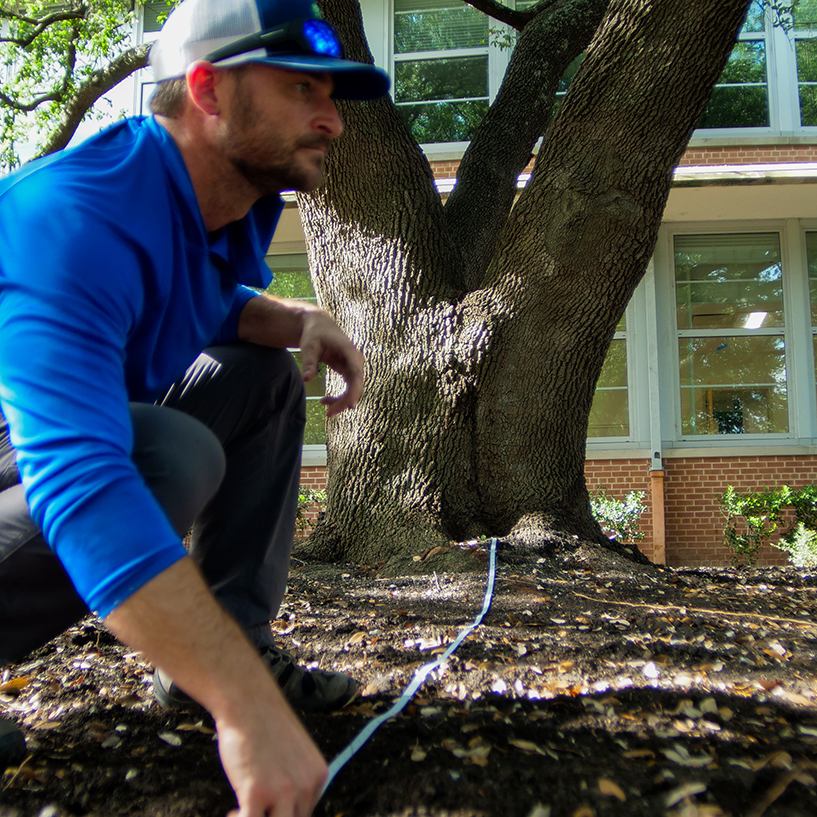
Mapping the Critical Root Zone (CRZ): We map out a radial grid pattern starting roughly 3 to 8 feet away from the trunk (avoiding the large structural anchor roots) and extending out to the tree’s dripline.
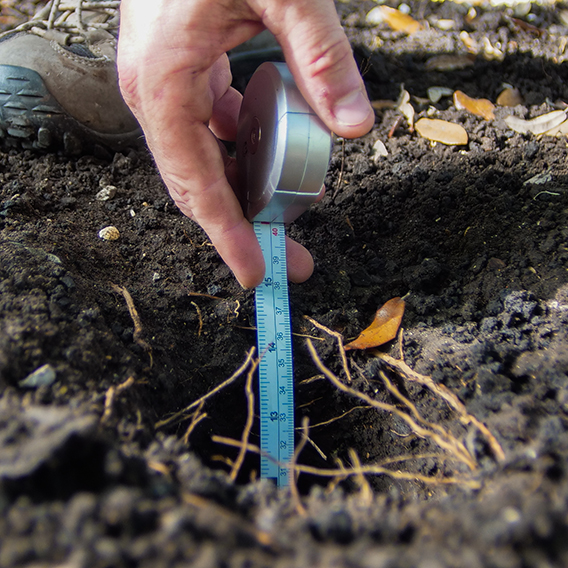
Pneumatic Excavation or Drilling: Using specialized tools—such as a high-velocity AirSpade or an auger drill—we create precise holes roughly 2 to 4 inches wide and 8 to 18 inches deep. 
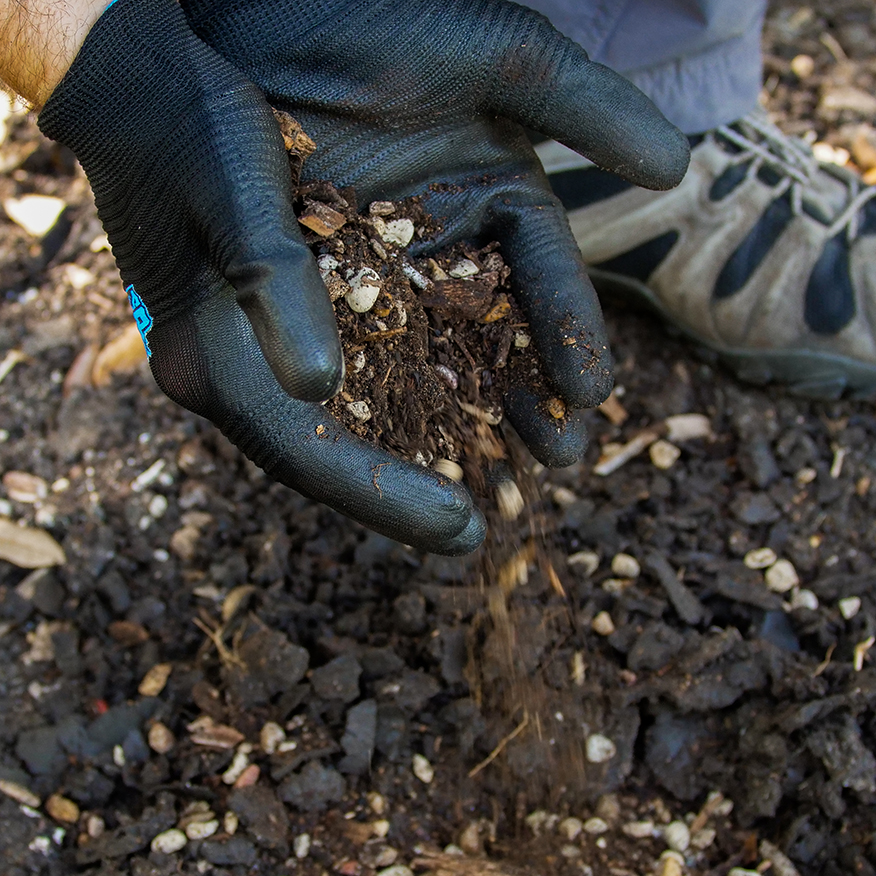
Backfilling with a Power-Blend: We discard the old, compacted clay and fill these brand-new columns with a porous, premium blend of organic compost, aged mulch, and sometimes liquid macro-nutrients.

The Benefits of Vertical Mulching for North Texas Trees

1. Instant Air and Gas Exchange

By swapping out columns of dense clay for highly porous organic material, we instantly reintroduce oxygen straight to the subterranean level. The tree roots can finally “breathe” again, facilitating immediate gas exchange.

2. Upgraded Water Penetration

During dry spells, these vertical mulch columns act like subterranean funnels, drinking up water and directing it deep into the subsoil where it is safe from rapid evaporation. Conversely, during abnormally wet periods, they help prevent waterlogging by improving drainage.

3. Deep-Tier Nutrition

Your lawn is a competitor. When you broadcast standard fertilizer over your yard, the turfgrass absorbs the vast majority of it. Vertical mulching deposits premium nutrients deep below the grass root line, ensuring your tree gets the exclusive buffet it deserves.

4. New Feeder Root Development

Tree roots naturally seek out paths of least resistance and high nutrient density. Within a couple of seasons, thousands of new, microscopic feeder roots will snake directly into these organic columns, rapidly improving the tree’s overall structural vigor and drought tolerance.
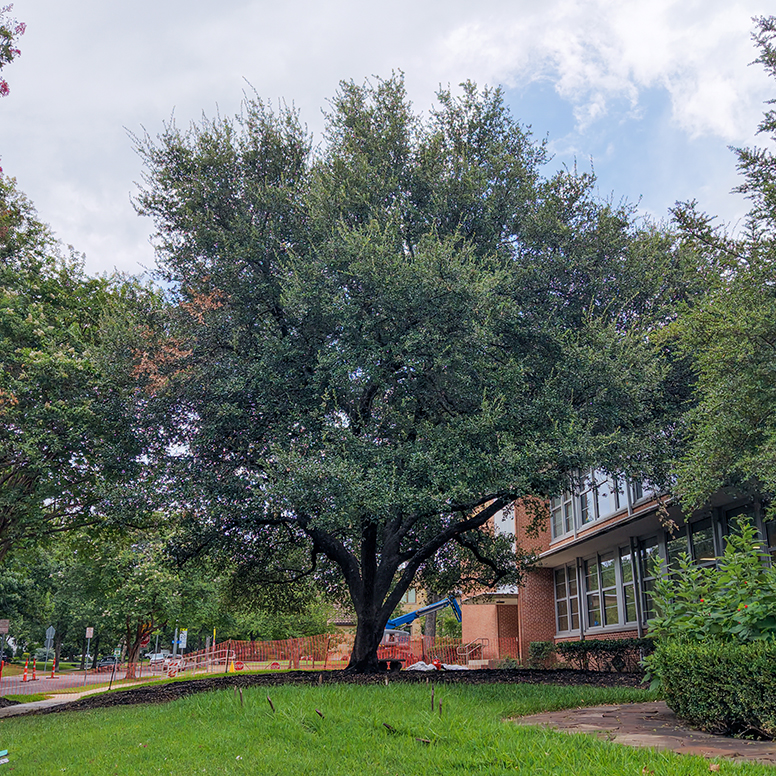
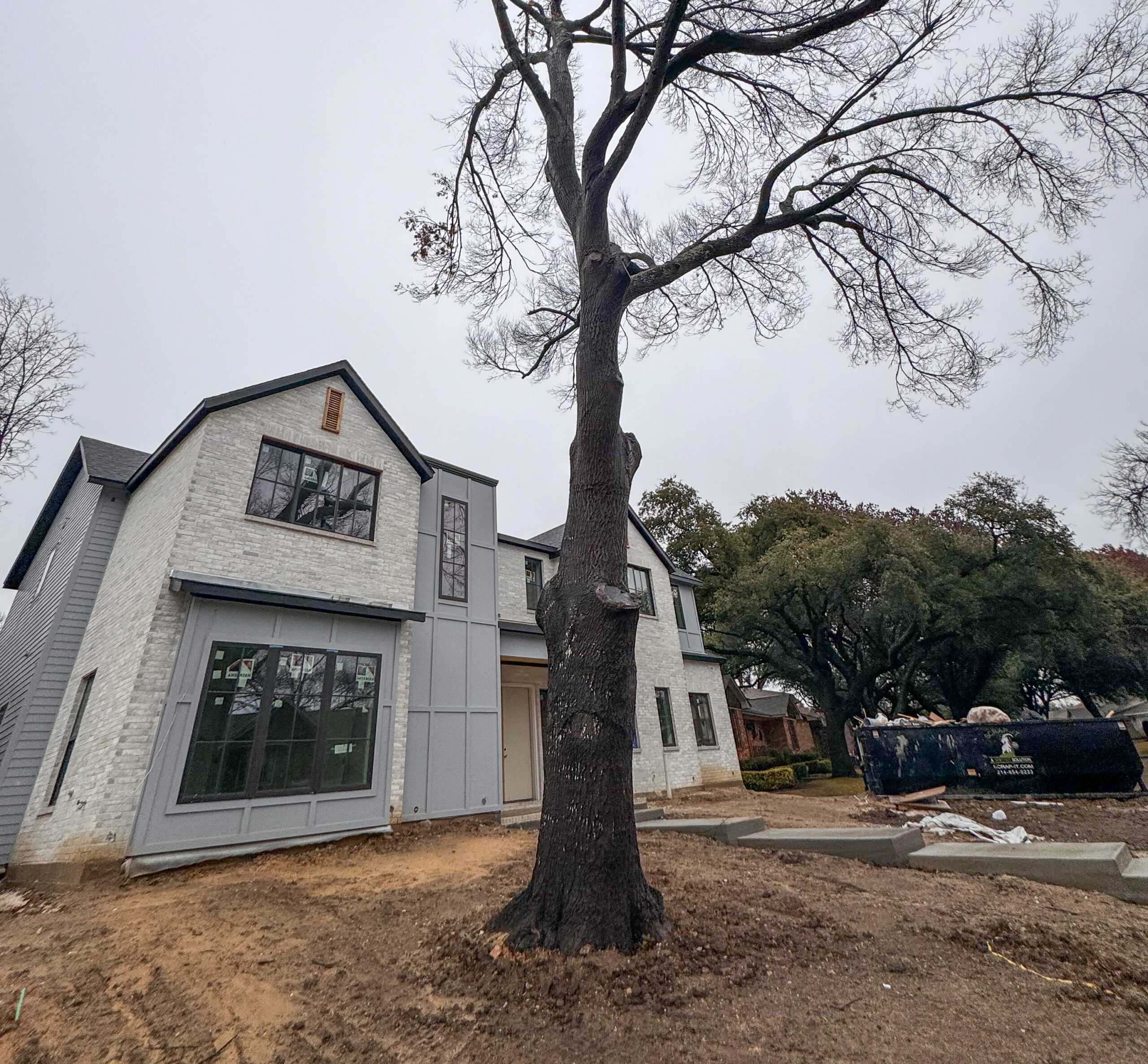
This live oak tree was planted in 1988, in 2026 construction occurred without a proper protection plan in place. Vertical mulching has been used to help reduce compaction damage that occurred.

When is the Best Time to Vertical Mulch a Tree?

While vertical mulching can technically be performed throughout the year, the optimal window in Dallas is during the late fall and winter months when the tree enters its dormant stage.

Stressing or cutting minor fine roots during the blistering summer heat can exacerbate heat stress. In the winter, however, the tree is resting, and those fine roots will vigorously regrow into their new, nutrient-dense home just in time for the spring flush.

Do not expect overnight miracles. Trees operate on a much slower timeline than smaller landscape plants. It may take one to two growing seasons before you notice a significant thickening of the canopy and a return to that rich, vibrant leaf color.

If your property’s trees are looking a bit tired, or if you’re planning construction near an old favorite canopy, don’t let compacted soil starve them out.

We love Trees Texas Tree Surgeons Logo

At Texas Tree Surgeons we love trees. Tree protection zones are the best way to protect your trees from compaction during construction. Vertical mulching can help reduce harm to the trees root system if a construction protection plan was not in place. Proactive care is always better than reactive.
Share This Blog
PREV BLOG

Search Within Blogs

Recent Posts

  • Your Guide for Pecan Trees in North Texas
    Fun fact, pecans are not technically a nut but a drupe. […]
  • Why is Tree Topping Harmful?
    We believe good pruning should be intentional, minimally invasive, and guided by how trees grow – not how fast we want them to shrink! While tree topping might seem like a straightforward solution for managing large trees, it poses significant risks to their health and longevity. […]
  • 9 Tree Maintenance Services Every North Texas Resident Should Know
    Caring for trees in North Texas requires more than […]
  • Understanding Tree Cycles: Discovering the Best Time to Prune Trees in Texas
    Trees follow natural growth cycles that affect how they respond to pruning. Most trees actively grow during spring and summer, using their leaves to make and store energy. […]
  • Crape Myrtle Care Made Easy: 9 Tips for North Texas Landscapes
    While crape myrtles trees are relatively low maintenance, a few region-specific care practices can make a meaningful difference in their health and appearance. […]

Ask Texas tree Surgouns

  • Tree Species
  • News Coverage
  • What's Wrong with My Tree
  • Local Arborist Services
  • Consulting
  • Tree Planting
  • Tree Removal
  • Tree Trimming
  • Tree Health Care
  • Roots
  • Insects & Diseases
  • Tree Recommendations
  • Turf & Trees
  • Extreme Weather
  • Fall Tree Care
  • Spring Tree Care
  • Summer Tree Care
  • Winter Tree Care
  • Top 10
  • Resources
  • Tree Owner's Guide
  • Ask Texas Tree Surgeons
  • Events
  • Video

Follow

Recent Comments

    Archives

    • July 2026
    • June 2026
    • May 2026
    • April 2026
    • March 2026
    • February 2026
    • January 2026
    • December 2025
    • November 2025
    • October 2025
    • September 2025
    • August 2025
    • July 2025
    • June 2025
    • May 2025
    • April 2025
    • March 2025
    • February 2025
    • January 2025
    • December 2024
    • November 2024
    • October 2024
    • September 2024
    • August 2024
    • July 2024
    • June 2024
    • May 2024
    • April 2024
    • March 2024
    • February 2024
    • January 2024
    • December 2023
    • November 2023
    • October 2023
    • September 2023
    • August 2023
    • July 2023
    • May 2023
    • February 2023
    • October 2022
    • September 2022
    • August 2022
    • May 2022
    • April 2022
    • March 2022
    • February 2022
    • January 2022
    • October 2021
    • September 2021
    • July 2021
    • June 2021
    • May 2021
    • March 2021
    • February 2021
    • January 2021
    • December 2020
    • November 2020
    • October 2020
    • August 2020
    • June 2020
    • April 2020
    • March 2020
    • February 2020
    • January 2020
    • December 2019
    • November 2019
    • October 2019
    • September 2019
    • August 2019
    • July 2019
    • June 2019
    • May 2019
    • April 2019
    • March 2019
    • February 2019
    • December 2018
    • November 2018
    • October 2018
    • September 2018
    • August 2018
    Related

    Related Blogs

    Similar blogs related to this topic
    All Blogs
    Tree Species

    Your Guide for Pecan Trees in North Texas

    Pecan trees are about as Texan as it gets—long-lived, generous, and a little particular about how they’re treated. With the right approach, they provide both dependable shade and a seasonal harvest. Not a bad return…

    Read more Jul 07, 2026
    Local Arborist Services

    Why is Tree Topping Harmful?

    It may seem like a quick fix for an overgrown tree, but topping often creates long-term problems that outweigh any short-term results. Understanding why tree topping is detrimental – and what to do instead –…

    Read more Jul 02, 2026
    Local Arborist Services

    Entire Arborist Staff are Prescription Pruning Qualification Certified

    Texas Tree Surgeons is proud to announce that all of our certified arborists can add Prescription Pruning Qualification Certified to their list of credentials. Lindsey Bramer, General Manger Will King, Consulting Manager Hannah Edinburgh, Arborist…

    Read more Mar 13, 2026
    Contact Us

    Get Your Estimate Today!

    Ready to get started? Have a question? We’d love to hear from you. Request an estimate and get started today.

    Contact Us
    Locations

    Areas Served

    Tree Services in and around the Dallas-Fort Worth Metroplex.

    • Dallas
    • Grand Prairie
    • Plano
    • Denton
    • North Richland Hills
    • Southlake
    • Fort Worth
    • Lewisville
    • Carrollton
    • Highland Park
    • Euless
    • Colleyville
    • Arlington
    • Frisco
    • McKinney
    • Grapevine
    • Garland
    • Wylie
    • Irving
    • Richardson
    • Coppell
    • Mesquite
    • Farmers Branch
    • Flower Mound
    • Keller
    • Addison
    • Rockwall
    • Prosper
    • Allen
    • Murphy
    • University Park
    • Trophy Club
    view more
    footer logo

    Dallas Tree Surgeons or Texas Tree Surgeons? Both! Same great people. Different name.

    • 469-387-6000
    • [email protected]
    Services
    • All Services
    • Local Arborist
    • Tree Health Care
    • Tree Removal
    • Tree Trimming
    • Tree Planting
    • Stump Grinding
    Quick Links
    • About
    • Contact Us
    • Faqs
    • Privacy Policy
    • Terms and Conditions
    Follow us on

    "Dallas Tree Surgeons" and "Texas Tree Surgeons" are registered marks of Tree Surgeons LLC.

    Copyright ©2018-2024 Tree Surgeons LLC

    Stay Connected With Texas Tree Surgeons

    * indicates required
    🇺🇸
    Texas Tree Surgeons - By providing your phone number and checking the box, you agree to receive promotional and marketing messages, notifications, and customer service communications from Texas Tree Surgeons. Message and data rates may apply. Consent is not a condition of purchase. Message frequency varies. Text HELP for help. Text STOP to cancel. See Terms and Privacy Policy
    Submitting...